Skip to content
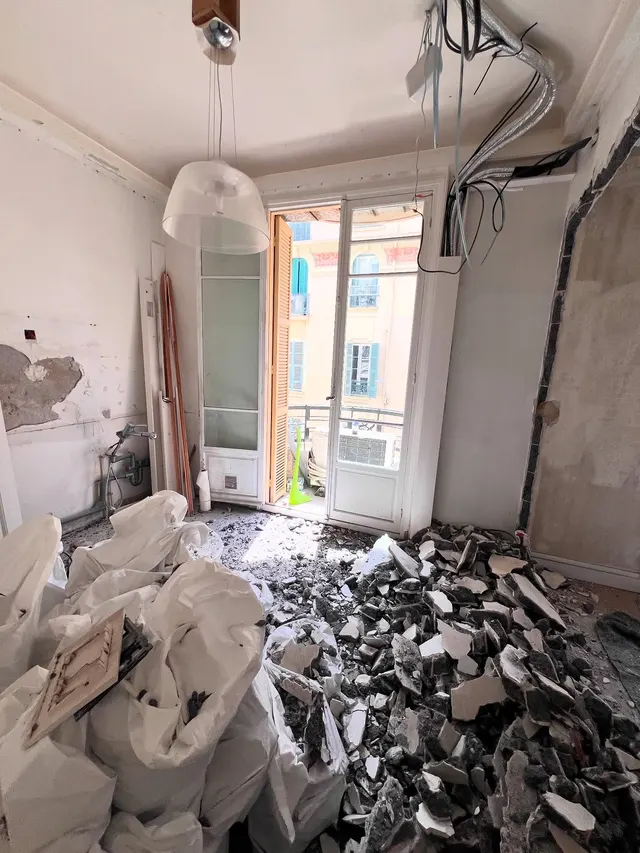
Room being demolished, rubble on the floor and electrical services exposed.

Demolition at home

Breaking things is quick. What costs is everything around it.

You
5 – 12 days
Budget
900 – 2 500 €
Steps
12

Times and budgets are indicative, for a confident DIYer, surprises excluded.

Knocking down a plaster-block partition takes two hours. That is exactly what misleads everyone. Demolition is not a matter of strength: it is a matter of preparation before, and logistics after. In between, the fun part lasts a day.

Before you swing anything, you need to know what carries load, what runs inside the wall and what the building contains. A 10 cm wall can be load-bearing. A partition can hide the neighbour's water supply. A home built before 1997 can contain asbestos. And in a copropriété (co-owned building), anything touching the structure or the common parts goes through a vote at the general meeting of the co-owners.

Afterwards, there is the rubble. A 10 m² wall in plaster bricks is more than a tonne to carry down the stairs, in 25 kg bags, without dirtying the entrance hall. The recycling centre limits what a private individual may bring; a skip on the public highway needs a permit from the mairie (town hall). And the dust circulates through the home for weeks.

The steps

1
/12

Know what carries load and what does not

Estimated time 1 – 2 days

Thickness settles nothing. You look at the drawings, at how walls stack from one floor to the next, at the direction of the joists, at the sound under a mallet. In doubt — which is common in older buildings in Nice — it is a visit on site that answers, not a forum.

Tools

  • drawings of the building
  • mallet
  • material detector
  • torch

What goes wrongA "lightweight" partition that was carrying load. Cracks appear in the flat above, and the repair costs more than the whole renovation.

2
/12

Find the services before you strike

Estimated time 0.5 – 1 days

Electricity, water, gas, ventilation: all of it crosses walls without warning. You switch the circuits off at the consumer unit, close the valves, scan, and cut inspection openings. A neighbour's cables may well pass through your partition: that is common in older buildings.

Tools

  • metal and cable detector
  • voltage detector
  • hole saw

What goes wrongOne blow of the chisel into a buried copper pipe. The water goes into the floor, and it is the ceiling below that announces it.

3
/12

Have the asbestos and lead survey done

Estimated time 0.5 – 1 days

Tile adhesives, floor tiles, renders, ducts: asbestos hides in ordinary materials from before July 1997. The survey before works is compulsory as soon as a company is involved. Lead concerns paints from before 1949. Both are measured in a laboratory.

Tools

  • certified surveyor

What goes wrongBreaking before you know. The fibres are spread through the whole home, and the decontamination goes beyond the budget of the job.

4
/12

Go through the co-owners when you have to

Estimated time 0.5 – 1 days

Anything touching the structure, the façade, a soil stack or a ventilation duct belongs to the common parts: authorisation from the general meeting is required. The file has to be prepared, and the meeting is held once a year, or as an extraordinary session. Count in months, not weekends.

Tools

  • copropriété rules
  • technical file
  • syndic (building manager) contact

What goes wrongWork starts with no vote. The syndic has the job stopped, and putting things back is argued out in front of a judge.

5
/12

Protect the building: hall, lift, stairs

Estimated time 0.5 – 1 days

The job starts downstairs. Hall floor covered, stair nosings protected, lift car lined with cardboard. Half a day that spares you most of the complaints — and it is what the neighbours will see of your works before they hear the noise.

Tools

  • protective cardboard
  • site tape
  • protective film
  • protective matting

What goes wrongMarble in the hall scratched by a rubble sack. The co-owners have it repaired and send you the bill.

Entrance hall of a building in Nice protected with a runner before works.
6
/12

Protect the home and contain the dust

Estimated time 0.5 – 1 days

Floors sheeted and boarded over in the circulation routes, doors of the untouched rooms taped shut, ventilation ducts blocked off. An airlock of plastic film at the entrance changes everything. Otherwise plaster dust gets everywhere: hinges, switches, appliances.

Tools

  • heavy dust sheets
  • plastic film and a zip airlock
  • tape
  • class M site vacuum

What goes wrongThe ventilation is left open. The dust travels up the ducts and comes out at the neighbours' for months.

Sheeted floor and protected room during an internal demolition.
7
/12

Strip out before you break: the soft strip

Estimated time 2 – 4 days

Everything that can be unscrewed comes off before the sledgehammer appears: doors, cupboards, sanitaryware, radiators, wall tiles, skirtings. The soft strip is long, repetitive and unglamorous, but it sorts the waste at source. It is often half the total time.

Tools

  • crowbar
  • cordless screwdriver
  • adjustable spanner
  • reciprocating saw
  • rubble sacks

What goes wrongA radiator taken off without draining the system. You find the water from the entire installation on the floor.

Old bathroom stripped back during the soft strip, wall tiles removed.
8
/12

Take down the partitions

Estimated time 1 – 3 days

You break from the top down, in sections, keeping the routes clear. A plasterboard partition comes apart almost cleanly; plaster blocks go with a hammer and a sledge. Damp them down lightly and take the rubble out as you go.

Tools

  • sledgehammer
  • chisel
  • crowbar
  • reciprocating saw
  • FFP3 mask
  • gloves
  • goggles
  • ear defenders

What goes wrongLetting a tonne of rubble pile up on an old timber floor. That concentrated load is a real risk.

Room being demolished with rubble sacks stacked on the protected floor.
9
/12

Have an opening in a load-bearing wall designed

Estimated time 1 – 2 days

Here you demolish nothing yourself. A structural engineer calculates the span, the lintel or the steel beam, the bearings and the propping. In a co-owned building, that note feeds the file for the general meeting. Your part: the measurements and the wait, several weeks of it.

Tools

  • structural engineer
  • dimensioned survey
  • photographs of the existing

What goes wrongAn opening made with no study and no propping. The wall moves, the floor drops a few millimetres, and the whole flat cracks.

10
/12

Get the rubble out

Estimated time 2 – 4 days

Bags of 25 kg maximum, otherwise they tear in the stairwell. You go down in small runs, load up and sort: inert waste, wood, metal, plaster. The recycling centre limits the volume a private individual may bring, and a skip on the public highway needs a permit.

Tools

  • heavy-duty rubble sacks
  • sack truck
  • wheelbarrow
  • handling gloves
  • van (hired)

What goes wrongPlaster mixed in with the inert rubble. The skip is refused at the sorting centre, or re-invoiced at the mixed-waste rate.

Lift car fully protected with cardboard before the rubble is carried down.
11
/12

Make good what the demolition damaged

Estimated time 2 – 4 days

A demolished partition always leaves a mark: a strip of untiled floor, a scar on the ceiling, a plaster joint on the walls either side, a skirting that stops short. These repairs are not demolition, but they are born of it — and they are counted in days.

Tools

  • filling plaster
  • jointing tape
  • skim coat
  • straight edge
  • filling knives

What goes wrongThe mark on the floor is wider than expected, and the original tile no longer exists. The whole room has to be redone.

Walls stripped back after removal, bare masonry ready to be made good.
12
/12

Clean up the dust — properly

Estimated time 1 – 2 days

Plaster dust does not vacuum up in one go: it settles again. Several passes with a fine-filter vacuum, a few days apart, before you skim or paint. Otherwise the first coat grips badly, and it shows.

Tools

  • class M site vacuum
  • microfibre broom
  • floor cloths
  • spare filter bags

Do it yourself, or have it done

  • You can do this
  • Better left to a pro
  • Regulated by law
  • You can do thisRemoving furniture, doors, sanitaryware and radiatorsLong but no structural risk, provided the water is off and the system drained first.
  • You can do thisRemoving wall tilesWithin reach with a chisel; expect the substrate to come with them, and filling to follow.
  • Regulated by lawAsbestos and lead survey before worksCompulsory as soon as a company is involved in an older building, and reserved to a certified surveyor.
  • You can do thisTaking down a non-load-bearing partitionFeasible once it is established that it carries nothing and the services are located — neither condition is a detail.
  • Regulated by lawAn opening in a load-bearing wallStructural study, propping and, in a co-owned building, a vote of the general meeting: the work commits the whole building.
  • Regulated by lawAny work on a gas pipeAny change to a gas installation is for a professional, with a certificate of conformity endorsed by an approved body.
  • Regulated by lawRemoving or moving a soil stackIt is a common part: with no authorisation from the general meeting, putting it back is at your expense.
  • Regulated by lawA skip standing on the public highwayOccupying public space needs a permit from the mairie, with a set duration and location.
  • You can do thisCarrying down and sorting the rubbleNo technique, a lot of back: the item where your time most directly replaces money.

You or Zenith

You

  • 5 to 12 days of your time, half of it in stripping out and carrying
  • €900 to €2,500 of hire, protection, bags and disposal (indicative)
  • No recourse if a crack appears at the neighbour's upstairs
  • The copropriété, town hall and recycling centre formalities to handle yourself
  • Weeks of dust before you can skim and paint
  • A whole building that hears you, every single day

Zenith

  • Free quote within 48 h
  • One contact from floor to ceiling
  • Price agreed before work starts

Price range

  • Loading…
  • Loading…
  • Loading…

Range excl. VAT — VAT varies with the type of work

Indicative range, not contractually binding.

This estimate is not a quote: the final price is set with you, after a site visit.

Common questions

How do you know whether a wall is load-bearing?

Thickness and the sound under a mallet give an indication, never a certainty: in an older building a 10 cm wall can carry load. The drawings, how the walls stack between floors and the direction of the joists are the real clues. At the slightest doubt, have it confirmed on site.

Can you knock down a partition yourself in a flat?

Yes, if it really is non-load-bearing, if the services crossing it have been located and isolated, and if asbestos has been ruled out. The breaking takes a day; the protection, the sorting and the disposal take three.

Do you need permission to take down a wall in a co-owned building?

For a private, non-load-bearing partition, no. As soon as the work touches the structure, a façade, a stack or a shared duct, authorisation from the general meeting is required — and the meetings calendar becomes your works calendar.

What do you do with demolition rubble?

Sort at source: inert waste, plaster, wood, metal. The recycling centre accepts limited volumes from a private individual; beyond that you need a skip, and a skip on the public highway needs a permit from the mairie. Count several hundred euros per skip (indicative).

How long does demolition take in a 60 m² flat?

For a complete strip-out on your own, count on 5 to 12 days of actual work, protection and disposal included. A company thinks in teams and skips, not weekends: that is where the gap in duration opens up.